“I don’t need my name in lights”

A few months ago my husband asked a probing question:

What would you do if you woke up famous?

Like everyone-knows-my-face-and-name famous, I questioned.
Yep, he responded, like that.

He was intent on an answer.  And I was quiet, searching for one. Then.

I’d be lying if I said I don’t want success. That I don’t want to be recognized for talents I believe I have. But famous?? That is entirely different.

Contrary to what I may seem, I am an introverted person. I love flying under the radar, allowed to notice and not be noticed. I love peace and quiet. I love being with myself–wholly–even in the dark moments when I’m skillfully negotiating the craggy peaks of my heart’s hurt. I love being allowed that luxury, the luxury of figuring out who I am without the noise of others telling me who they think I am.

Surely, that doesn’t mean there aren’t those in my life who try to make their truth my own.  There are.  But at least they know me. They aren’t complete strangers who take issue with the way I cut my hair, what I choose to eat, or worse…who attack my sacred personhood because of something they read or watched on t.v.

So that famous??
No. Thank. You.

Then last week, while driving to meet a girlfriend for lunch, I was heart hit by a song on the radio:

I don’t need my name in lights
I’m famous in my Father’s eyes
Make no mistake
He knows my name
I’m not living for applause
I’m already so adored
It’s all His stage
He knows my name

As I drove through tears, I realized I’m already famous to a precious and cherished few. They know my name and more than that…they know my heart. That is why the song moved me.  Because it spoke to one of my deepest truths: on any given day, I’d prefer to be Known than known of.

That is my heart’s scripture. Today. Tomorrow. And forever.

I don’t know what the next few years will bring. And I don’t know where my talents will take me, but it doesn’t matter.  I am Known.  And that knowing is more fame than I ever dreamed of.

My Sacrifice Upon Autumn’s Altar

If I could choose one season in which to live eternally, it would undoubtedly be fall: when the leaves start to change, the air smells of mist and cloves and my favorite apple orchard, Curran’s, begins selling its much coveted apple cider doughnuts.

To me, there’s nothing more beautiful than fall: its sights, its smells, and the emotion its return evokes. I was reminded of the latter this past Tuesday at my monthly pregnancy loss support group. In truth, I’ve only attended 3 times, but sitting among women who bear the same scars, helps me embrace my truth: I am childless but not less because I am without child.

Our meeting, usually led by one mediator, was led by two that day. The addition, let’s call her Hope, again reflected my true self back to me: that of a survivor who is inking her edges with truth, much like the autumn leaves ink theirs with vibrant color.

Hope began talking about the changing seasons and how it is a standing metaphor for the seasons of our lives. Of course, I had heard that before, but it sounded different, sweeter maybe, coming from her. I noticed her hands lay upon two piles of construction paper leaves, one dark and one light, and imagined her sitting in the quiet of her kitchen tracing their lines, then delicately cutting along their penciled edges. Perhaps she was drinking cider at the time, wrapped in a fluffy sweater, as she thought about how she’d been where we now are. How, like me, she’d suffered 3 losses; and how, unlike me, she is now mother to four living children.

She looked at her small, untidy piles and told us that the first leaf represented something we’d like the winds of fall to blow away, or, put in my heart vernacular, something we’d like to sacrifice on autumn’s altar. As she passed out the leaves, I thought about those winds and that altar and only one word came to mind:

frustration

frustration

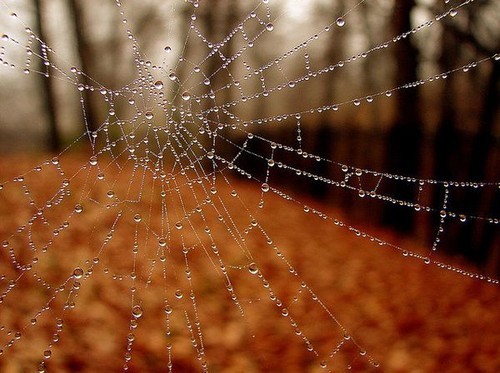
I have been dealing with an abundance of frustration lately, most of it directed toward myself, but some of it reserved for R and the place we find ourselves in. And sadly, I’ve allowed that emotion to steal my joy, robbing me of a purpose that is greater than me or any loss I have suffered: that of a bloomingspider, who spins webs of truth to net hearts.

So, I laid that emotion on the altar, placed a hand over my heart and slowly backed away.

It remains there. And I remain here.

For now.

The second leaf was a gift to give ourselves. What flooded my heart was this:

The courage to move on

the courage to move on

The courage I write about is two-fold: the courage to walk toward another try with fullness of heart and spirit, as well as the courage to accept a childless life, if that is where this path leads. Neither will be easy, I know. But I’d like to think that I can look both in the eye and be better on the other side of whichever awaits.

The winds of fall blow in and out. If we allow, they can rid us of untruths, traumas and the plague of closed fists, filling us instead with gifts wrapped in the jewel-toned paper of grace and the billowing ribbon of acceptance.

Image courtesy of AnnMarie Bone via annmariebone.deviantart.com

Image courtesy of Ann Marie Bone via annmariebone.deviantart.com

As always, it is a choice.
And one I hope we’ll both make.

Until I spin my next web,
Dani

Emerging to Own Myself Again

ever-upward

Some time ago, fellow blogger and sister-in-loss, Justine Froelker, reached out and asked me to review a chapter of her upcoming book, Ever Upward: Overcoming the Lifelong Losses of Infertility to Own a Childfree Life. I’ll admit I was hesitant, since reading and somehow “grading” a person’s heart notes can be scary, especially if the relationship isn’t the stuff of marrow and soul. But I wanted to do it for her, in honor of the heart shards we share.

The chapter title which spoke to me most was Chapter 8: Emerging to Own Myself Again. The visual representation I had was of a wounded butterfly recocooning itself to heal, yet reemerging, after a Season of grief and recovery, better and stronger because of its traumas or, as Justine calls them, “soul scars”. It is precisely that image that Justine puts into words:

It was with these words, “own and not just prove”, that I felt my calling, my purpose. I needed to own every single part of my story and not just prove it. I needed to stop trying to prove that my path is okay. That not doing another round of IVF is okay. That not being a mother is okay. That not adopting is okay. Stop trying to prove it and just own it. Own my struggles in the IVF world. Own that I stopped treatments. Own that I don’t want to adopt. Own that I am more than childless. Own that I will practice and fight for my recovery and my own childfree life.

Despite the fact that our stories are similar, I don’t pretend to understand all that Justine has suffered. I am, now more than ever, keenly aware of the breadth and depth of the loss spectrum. And surely, if I have learned anything about grief and recovery, it is that each is uniquely personal. Truly, a pebble thrown in the well of the heart will never make exactly the same ripple twice. And I believe it is designed that way. As my husband says, “God is not a god of repetition”: no two trees are alike, no two flowers and yes, no two traumas are either.

Justine’s chapter reminds me of this and what waits for us on the other side:

We are only capable of understanding so much in this life, and maybe we’re only allowed to understand so much. Maybe I will always have to create this constant balance between finding my purpose through the story of my struggle, making sure it means more, at least to me, and trusting that it will still mean just as much without the soul-completing clarity I so desire.

Perhaps the anger will hang on; perhaps the question of whether or not to try again will be a daily, if not an hourly, one; perhaps our sacred light will be snuffed out, at least for awhile; but Justine reminds us that there is more after loss. There is joy, and purpose, and yes…

There. Is. Life.

If you need that reminder, or if you’d like to share that reminder with someone else, you can pre-order now or purchase the book on October 1, 2014 here .

Until I spin my next web,
Dani

Healing, like grief, comes in waves

I have avoided Orlando for four years. In my most honest places, that is what’s whispered to me as we pull in and see a small figure waiting for us in the doorway: that of my 94-year-old grandmother, Catherine. She is smaller than I remember, frailer too, but she still gives the best hugs: the kind where her hands run up and down your back, making a final squeeze near your shoulder blades. The kind that give you enough time to take in her scent: Swiss lotion mixed with a hint of Neutrogena.

The house remains the same: the kitchen linoleum still feels tacky beneath my bare feet, the pictures lining the shelves and walls are in precisely the same place, the back bathroom still smells of Dove soap.

Four years ago we were here and found out we were expecting for the second time. The first hadn’t ended well, but we were hopeful despite. I remembered the wee hours of that July morning, waiting for EPT to confirm what my heart already had. I remembered our walk afterward, talking about how everything would change. How the blessing of that sacred knowledge would remain Ours until the right time.

How the right time never came.

How it has never come.

I had looked Brazil in the face, thanked her and scorned her for all she gave and took. But I hadn’t done so here. I hadn’t traced the lines of rooms where I’d been so happy before being so sad. I hadn’t wanted to. I wasn’t ready to. Until now.

Maybe Grandma knew. Maybe she knew that grief had pushed me away. But healing had brought me back. And I was reminded then how both come in waves: some that roar and crash into your deepest places, others that touch so softly, you barely realize they’re even there.

On our third day together, Grandma mentioned the two things she’d like to do before she dies: see the ocean and visit the cemetery where my aunt and grandfather are buried. R and I had planned to make the trip to Daytona to do the same, so I told her we’d take her. The next morning she told me she thought she’d stay behind. She gave reasons, reasons similar to the ones I’d told myself during my four years away. And I knew what was happening. The waves were crashing in. She knew it. And so did I.

I told her we’d be there with her, that God had given us a beautiful day, and that we’d understand if she decided to stay. But she didn’t; thirty minutes later we were heading to Ormond Beach with Grandma in tow. I had forgotten the palms on I-4 East, the lush green peppering both sides. I had forgotten Atlantic Avenue’s concrete jungle and the number 1015, where my grandparents’ motel, The Holiday Shores, had stood. And I’d forgotten the exact spot of the graves, but found them after walking a familiar path: two rows in and toward the middle.

R and Grandma at the cemetery.

R and Grandma at the cemetery.

Grandma had chatted the whole way down. She told us how she’d been so mad after hearing the news that Grandpa Paul had bought a yacht, that she’d driven 90 miles an hour all the way home. “The Good Lord got us there safely,” she’d said. And I knew she believed it. When we crossed the Halifax River, she told us that’s where she’d learned to fly a seaplane. She was pregnant at the time, but Grandpa Paul has insisted, growing belly and all. She told us about his sit-down with Norman Brinker and the subsequent opening of their very first Steak and Ale restaurant. And then, in the hush of the cemetery, she told us about my grandfather’s last days. How her last words to him were, “Are you feeling okay, Chuck?” And how he fell over afterward, right there at the breakfast table. “I think he knew it was coming,” she said. “He knew.”

Grandma and I.

Grandma and I.

We were quiet then: R and Grandma in front of Grandpa Paul’s grave, me in front of Aunt Kathy’s. And I felt a surge of emotion so strong, I began to cry: for them (All of them) and for us left behind. I cried for my aunt, who was only 18 when she passed. I cried for her life, short-lived. For those who truly knew her, like Mom. And those who’d longed to, like me. I cried. One hand on my heart, the other on her grave. One hand saying goodbye, the other a heartfelt hello.

On the way back to Orlando, Grandma talked about Aunt Kathy. How she’d wanted that car so badly. How her girlfriend had had one. How Grandpa Paul went to Miami to get it. How it was a surprise. And how that morning, my Aunt’s last morning, she’d left Grandma a note, which read: “I took some change from the cupboard, Mom.” She’d signed it, “The Brat,” a name she called herself. A name that, looking at my Grandma, I knew had not and will not be forgotten.

The waves of grief and healing come. I relearned this with Grandma. Sometimes one is pushed by the other. Sometimes they arrive in tandem. But always, always, they come.

Those four days with my grandmother were sacred. We shared and rode the waves together, whether she knew it or not. She helped me remember that one does reach the other side of grief. And that the other side is written with gratefulness for what was had, not bitterness for what was lost.

Thank you, Grandma.

For your time. For your lesson.
And for your love.

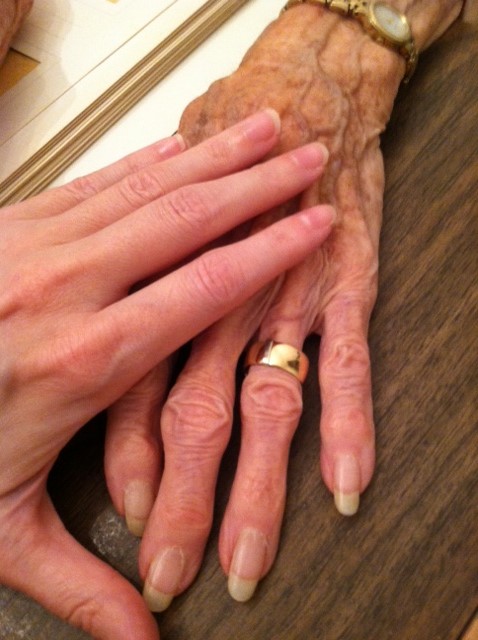
Our hands

Our hands.

Elizabeth Berg, a man named Andre, and writing true

On August 16, 2013, I kissed my husband curbside and anxiously entered the lobby of the Hyatt Regency Chicago. I was wearing my favorite jeans, a polka-dot blouse and my black pumps, the ones with the large leather bow near the toe. But the space felt wrong, like the cafeteria on the first day of school: a virtual minefield of social suicide and no map to guide.

I looked around, knowing full well I would find no familiar faces, but hoping I could spot aspiring writers, that perhaps our hearts would seem familiar to one another. And after a few trips up and down the stairs, I spotted them. Comrades in pen. Soldiers of prose.

We were all nervous. Sizing up the space and each other, then scanning the large area for a face we’d seen only briefly, if at all: that of Ms. Elizabeth Berg.

I had met Elizabeth previously, but doubted she’d remember me. I had been too nervous, too giddy that warm summer day when she’d spoken about the motivation behind her novels, including her most recent, Tapestry of Fortunes.
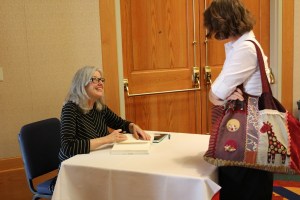
Meeting Elizabeth.  May 10, 2013.

Meeting Elizabeth. May 10, 2013.

Afterward, as she signed my copy, she told me of a workshop that was in the planning stages. It would be in Chicago. “If you’re serious about writing”, she told me, “I think it would be a wonderful experience for you. Please try to come.”

And then there I was, waiting for the first of three days with one of my most beloved authors .

Her latest novel, which I enjoyed, but doesn't hold a candle to my absolute favorite, The Pull of the Moon.

Her latest novel, which I enjoyed, but didn’t move me nearly as much as my absolute favorite, The Pull of the Moon.
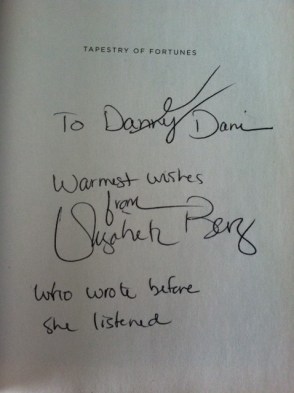
Elizabeth wrote my name before I spelled it, hence the addition of "who wrote before she listened" to the inscription.

Elizabeth wrote my name before I spelled it, hence the addition of “who wrote before she listened” to the inscription.

There were five of us: different ages, different backgrounds, different writing styles and different motivations for putting pen to paper. But we all had two things in common: we all loved Elizabeth and we all wanted to learn from her.
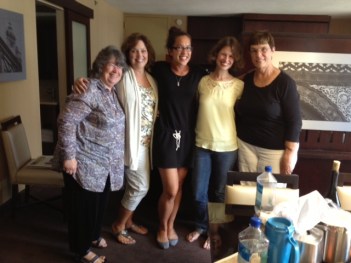
The ladies from the workshop (L to R):  Sandy, Ginny, Chrissie, Me and Marilyn.

The ladies from the workshop (L to R): Sandy, Ginny, Chrissie, Me and Marilyn.

She told us our time together would be sacred. That we would bond quickly, share more and share bigger because of the intensity of the workshop. She asked us to be open to feeling everything that came, even the terrifying and difficult. That it would make our writing more authentic. And then she said this:

“Don’t be afraid to feel. The good stuff is where the bullshit ends and the truth begins.”

I nodded my head in response and heard the tinny clang of my armor, heavy and protective: Bullshit. Yes, that’s what it was.

On day two, Elizabeth shared with us where our talents might best be suited. I had prayed all night for her lips to form the word novelist, but instead she told me she saw me as a children’s book author. And called my writing ethereal. Afterward, as we sat tight and straight like Popsicle sticks, I asked the ladies if they felt the same. Ginny, who I’d grown to adore, stepped closer, “It’s just what she thinks; it doesn’t mean anything…unless you think it does.” But it did. Elizabeth Berg was telling me I’d be a great children’s author. Perhaps she was right. Since she was Elizabeth Berg and all.

I was dreading day three. Its focus, dialogue, had never been my strength and I’d convinced myself it never would.

On that day, Elizabeth gave an assignment:

Today’s assignment is to go out and listen to people talk. It can be anywhere: on the street, in a restaurant, in a bathroom, in the hotel lobby, on public transportation. Pay attention not only to what they say but HOW they say it—you want to pick up on natural patterns of speech. What gets emphasized? What makes for pauses? Hesitations? Repetitions? Is there a strident quality to what they’re saying? A lyrical one? A dull one? How does emotion affect the way something is said?
…Try to replicate cadence, a natural and way of speech. Try to avoid clichés or dialogue that goes nowhere; have your assignment be a little story. Understand in your mind who these characters are before you make them talk: see them clearly in your mind.

I felt sick to my stomach. I had no idea where to go or what to write. So I wandered down Wacker, turned left on Michigan and saw a man standing in a doorway, a paper cup in his hands and a cardboard sign around his neck. Written there were two words:

I’m hungry

I looked at him as I passed, but I didn’t See him, and continued to walk until I found a door that looked interesting and walked through. I ordered my lunch, then sat at a table near the back, behind a young couple and away from the noise. She was pleading with him to stay together, despite their parents and their friends’ objections. But he heard nothing. He was messing with his iPhone and jamming to the tunes heard on his bright red headphones. She looked down, around and down again. And then there was silence.

I started to eat my lunch, but couldn’t forget the man’s face, his sign and those written words: I’m hungry. So, I got up, bought him some lunch and headed his way. When I held out my hand, he cocked his head and put his pointer finger to his temple. It stayed there as he sized me up and then extended his hand toward me:

“My name’s Andre.”
“Pleased to meet you, Andre. I’m Dani.”

I asked him if he’d mind having lunch with me to which he replied, “pull up some concrete”, which I did. He told me about losing his job, his apartment and his family. He told me about life on the street, sleeping under Wacker Drive, “which smells like trash and dead things…’cept in winter.” How his friend had a dog, “one of them smooshy ones with rolls” and how he helped them make it: “People seems more inclined to feed a starving man with a dog, ‘poor thing’, they always say.”

He told me about working in factories in Kenosha. And I watched him hide his hands as he told me how badly he wanted to shower, “to get clean, you know?”.

Then he told me this:

“Yous my present from God today. People don’t see me. But you, you stopped. And looked at me. That there’s a God thing, mam. Yous a God thing.”

I shook his hand again and told him I needed to get back. And then looked him straight in the eye: “It was nice meeting you, Andre. Thank you.”

I ran to the hotel and began feverishly scribbling the account of our conversation, as if I were watching from the outside. And when I shared it with my group, I cried, overwhelmed by what had happened and how he’d let me in. “That was a God thing,” I told them.


That first day in the Hyatt lobby was 365 days ago. One week later I started this blog and since then have referred back to things said by each woman who attended, to Andre, and, of course, to Elizabeth, who reminded us on our last day together:

“Writing is not a craft, it’s a calling.”

I know now I was called to this place and that I couldn’t fully be here without my traumas and triumphs. That you wouldn’t hear me or See me without them. So in honor of Elizabeth, Andre and my nearly one year blogging anniversary, I’d like to extend my heart in thanks to those who have sprinkled light and truth on my path, those who have Seen me and had the decency to hold my gaze in this precious space:

To Ginny, a beautiful writer and friend, thank you for believing in my voice and experiences. And thank you for believing others would as well.
To Charissa Grace, a wordsmith if I’ve ever known one, you are true heart. Thank you for being Family.

To Jane, a tender soul and talented writer, thank you for breathing kindness, acceptance and grace.
To Stephen, a man of passion and stalwart faith, thank you for your time, your willingness to consider and our continued conversations.

And finally, to Elizabeth Berg, who taught me about the sanctity of writing true. May you know I always will.

What forgiveness is

“No one’s need to be heard is so great that they should kill.”

– Jo Berry, Beyond Right & Wrong:  Stories of Justice and Forgiveness

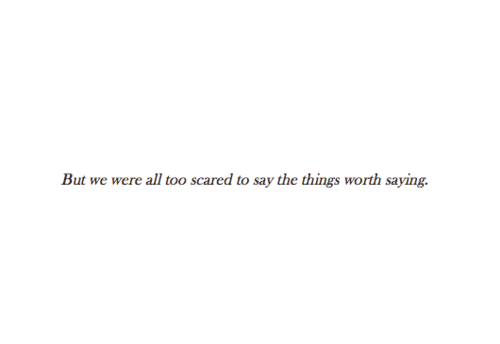
But we were all too scared

I. Forgive. You.

Three little words.

One immense impact.

We have all been forgiven and been asked to forgive.  It is as vital to life as the beats of our hearts.  But I wonder: how far is its reach?  Does it slip into the back pews of churches?  Does it sleep in the annals of international cities? Does it accompany a murderer as he walks toward his death?  Does it take refuge in places we dare never go?

I have forgiven many things: the heartrending and the petty, the soul-stealing and the trivial.  But I have never forgiven another human being for killing someone I love.  I have never seen scarlet ribbons descend from their bodies or heard their terror-filled screams. I have never been put in that place and pray I never will.  But the people in the documentary Beyond Right & Wrong:  Stories of Justice and Forgiveness have.  They exhale the loss and pain of those whose loved ones were taken, and inhale the redemptive power of forgiveness.

Watch Beyond Right & Wrong for free

Jo and Pat

From left to right:  Jo Berry, Robi Damelin and Patrick Magee

From left to right: Jo Berry; Robi Damelin, spokesperson for The Parents Circle Tel Aviv; and Patrick Magee.  Image via http://www.buildingbridgesforpeace.org

Jo Berry, founder of Building Bridges for Peace, is one such person.  Her father, Sir Anthony Berry, was one of five killed in the October 12, 1984 bombing of the Grand Hotel in Brighton, England.  Patrick Magee, the IRA soldier who planted the bomb, served 14 years in prison and was released in 1999 as part of the Good Friday Peace Agreement.  The two met for the first time in November 2000.

Pat has said this about Jo:

Well, one thing that, um, hit me, uh, after…I couldn’t tell you when exactly this happened.  You talked about your father and I got more a picture.  He was a human being, who had shaped you.  In other words, um, all the things that I admire in you came, in some measure, from your father <sil>. That means this was a fine human being <sil>.  And I killed him.

Berry and Magee have since shared a platform upwards of 100 times.  They work together to encourage non-violence and to opt for dialog and reconciliation versus revenge and retaliation.  While their interactions are not easy, Berry is learning “to give up blame and choose empathy.”

Bassam and Rami

Bassam on the left.  Rami on the right.  Image via www.the guardian.com

Bassam on the left. Rami on the right. Image via http://www.theguardian.com

Bassam Aramin, a Palestinian Muslim, and Rami Elhanan, an Israeli Jew and son of a Holocaust survivor, both lost their daughters.  Abir Aramin was standing outside her school when she was shot by an Israeli soldier.  She was 10.  Smadar Elhanan was walking to get books with two friends in Jerusalem when she crossed paths with two suicide bombers.  She was 14.

Image courtesy of Rami Elhanan via www.972mag.com

Image courtesy of Rami Elhanan via http://www.972mag.com

Their fathers are now members of Combatants for Peace, a movement of Palestinians and Israelis who were once dedicated fighters and now seek to end the conflict through dialogue and non-violence.

“We have both lost our daughters,” Rami says.  “We both paid the highest price possible.  Our blood is the same color.  Our pain in exactly the same pain and our tears are just as bitter.”

Bassam adds:

Abir’s murder could have led me down the easy path of hatred and vengeance, but for me there was no return from dialogue and non-violence. After all, it was one Israeli soldier who shot my daughter, but one hundred former Israeli soldiers who built a garden in her name at the school where she was murdered.

Bassam and Rami remain friends and have worked on a project documenting their lives, losses and steps toward peace.  It is called Within the Eye of the Storm: When Enemies Turn to Brothers.

Beata and Emmanuel

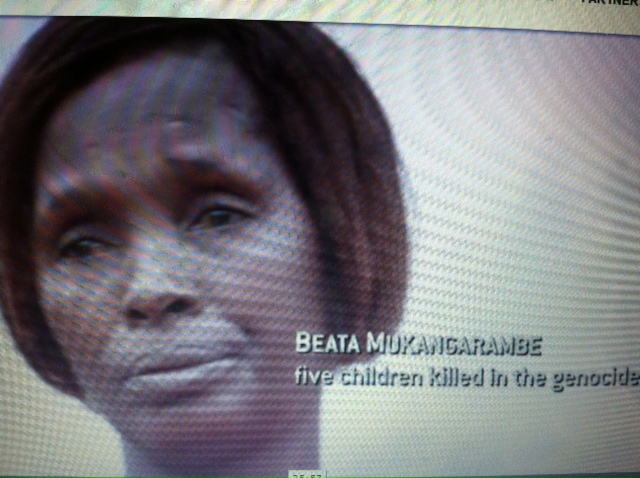
Beata Mukangarambe is a Rwandan genocide survivor; her five children are not.

Beata Mukangarambe_five children killed in genocide

“One day, a man came to see me…. He said, ‘Let me tell you something that makes me sad. I am the man who killed your children. Can you forgive me?’”

That man was Emmanuel Bamporiki.  He had just been released from prison after serving seven years for crimes committed in the genocide.  He spoke of his own personal pain.  Of being haunted by those he killed.  Of hearing the voices of children screaming for their mothers as they were chased down by men wielding machetes.

Beata collapsed.

Emmanuel went to beg her forgiveness three more times.  When she finally accepted these were her words to him:

“I have forgiven you.  I will never be angered by you again.  If you have a bicycle, do give me a lift.  If I have something that you do not have, I’ll share.  That is all.”

The lesson

Forgiveness does not erase the past.  It does not equal permission and does not mean you agree with the offender or his offense.  It means that you release him from judgment and release yourself from bitterness, hatred, and revenge.  Forgiveness is recognition that among our human complexities is our ability to do both good and evil, house both good and evil.  But that evil does not make us inhuman.  It makes us imperfect.

When I wake in the morning, I remind myself of who I could be:

I could be Israeli with eyes the color of sea glass and waist-length hair.  I could be a skinhead.  I could be a Tutsi child with legs like dandelion stems and a swollen belly.  I could be a terrorist ready to die for my cause.  I could be your sister, your mother, your enemy.  I could be you.  And you?  You could be me.

And if instead of backing away in fear, I walk forward, extend my hand and place it over your heart, its rhythm would feel the same as mine would to you.

Two hearts.  One heart.

One human heart.

With one message: forgive.


Sources:

Building Bridges for Peace.  WordPress. 2014. Web. 28 July 2014. <http://www.buildingbridgesforpeace.org&gt;

Spottiswoode, R. (Director), & Singh, L. (Producer). (2012). Beyond Right & Wrong: Stories of Justice and Forgiveness [Documentary]. United States: Article 19 Films.

Within the Eye of the Storm. n.p. n.d.  Web. 2 August 2014.  <http://www.withineyeofstorm.com&gt;

What will you say when I die?

I found this a few months ago while driving around my hometown.  It seemed appropriate.

I found this a few months ago while driving around my hometown. It seemed appropriate.

I watched the subtle rise and fall of my chest yesterday and wondered:

What if it stopped? What if my heart stopped right now?

It was a horrendous thought. Horrendous because I’ve chosen to spend my days thinking about how to fill them, not how they will someday end. Recently though, I’ve thought a lot about death. Not in a morbidly obsessive way, but rather in a matter-of-fact-this-is-going-to-happen way. Because it will. Sooner or later it will.

I’d like to believe that I will grow old. That I will wear sweater sets, use a cane and take heart in singing to plants and playing games of Scrabble. That I will take my last breaths in the comfort of my own bed after a life well lived. That I will have earned my laugh and frown lines. And that my spirit will still be young and strong despite its vessel being old and weak. But there is no guarantee that my end will be this way. There is no guarantee that my last heartbeats will be slow and steady as they march toward my death. And quite frankly, that scares me.

I once had a dream about my wake. I was laid in a white coffin, dressed in an outfit I’d never seen and covered head to toe in thin lace netting. My hair was done up, which I never do, and my lips were stained a garish red. The room was wall-to-wall with people, but no one passed in front of my casket. No one wept or extended their hand to cover mine. And when the priest asked if anyone had anything to share, no one spoke. No one.

I woke in a panic thinking about the hairsprayed coiffé, the horrible lipstick and the deafening silence. And suddenly all the horrible things I’ve done and said lay before me like the countless pebbles on that tiny beach in Maine.

Just love these.

Just love these.

I remembered my childhood and the mountain of untruths I told. I remembered how I laughed with my friends at Barbara Denk who smelled, we said, but to whom we never got close enough to test out. I remembered how I yelled at my Grandmere after she’d asked me 209 times where my Papa was. How He’s dead seemed utterly cruel to share with her Alzheimer-ridden mind. And how I once told a boy I still loved him just as he told me he loved someone else. I didn’t though. I just wanted him to love me instead. Those are just a few, of course; there are pebbles that are more grievous and some that are less. But all of them bring me back to the admonishment of earlier this year:

You are a good person, Dani. But you need to be better.

It had been a terrible Saturday. I was very ill and had started to shake uncontrollably, as I nursed pain that felt like a forest fire moving east to west inside my upper abdomen. Bishop and Sister Hall arrived as I was in the thick of it. And before I knew it, Bishop anointed my head with oil and began to pray over me. The prayer was earnest and simple, imploring for the pain to subside and my health to return. I felt his hands shake a little upon my scalp and heard a hitch in his breath as he invoked the name of Jesus Christ and finally said Amen. As he stepped away, I felt my body go limp and saw a flash of brilliant blues and pinks. Then he appeared.

He was glorious as angels go: a beautiful strong nose, bright blue eyes a shade lighter than my mother’s, and a kind upturned mouth. His hands were unblemished and rosy, like the skin of a newborn, his fingers long and delicate.

He called me by name and shared with me some of my truths. And if I remember correctly, he reached his hands toward me more than once. Because I remember wanting to reach back and hoping that that is what Heaven feels like.

Then he slowly began to back away and said this, his last words to me:

You are a good person, Dani. But you need to be better.

When I came to I was crying. I immediately told my husband about the angel and what he’d said, to which he responded with tears. He later reminded me that I was being pumped full of powerful drugs, that I wasn’t well, that perhaps I didn’t actually see what I saw. But I wouldn’t accept it. He called me by name; he knew my heart. It was real. And he was real too.

I haven’t seen him since that day and I’m okay with that. Seeing an angel once was more than I ever hoped for and I don’t plan on wasting his advice and admonition. And while I know what I know and know what I saw, I’m still terrified of dying. I’m still terrified of leaving this Earth before I’ve done something worth remembering, something that will move people to cover my hands with theirs as I lay still in my casket. Something that will render me forever a passenger in the hearts of those I love.

And then it hits me: perhaps the something, the big thing, isn’t a big thing at all. Perhaps it’s calling to let you know you’re thought of, laying with you when you’re sick or helping you when you can’t help yourself. Perhaps it’s giving my seat up on the bus, buying lunch for someone in need or running after exhausted parents with their little one’s stuffed giraffe. Perhaps all the big things I could do would mean nothing if I hadn’t done the little things. If my heart hadn’t been right. If I hadn’t been right.

I wish my younger self could hear that. I wish she would have let herself be known in ragged form instead of the person-shaped mask used to make her appear whole. And I wish I could go back, hold her hand, and tell her the two things I haven’t always known:

It will get better.
And you will be better.

Perhaps it shouldn’t have taken an angel to figure that out, but maybe, just maybe, that’s why he came. To let me know that I’m on the right track. To confirm that I’ve made mistakes, tons of them, many of which I don’t wish to relive. But I’m on the other side of them now. And I’d like to think, I’m better for them, as well.

I don’t know when my last heartbeats are coming, it’s better that I don’t. But I hope that when they do you’ll put your hand over mine and whisper something to my heart, if only from the quiet of your own:

You are better, Dani. You truly are.

One of the most beautiful cemeteries I've ever seen.  It's in L'Île-Perrot, Quebec.

One of the most beautiful cemeteries I’ve ever seen. It’s in L’Île-Perrot, Quebec.

Tadeusz Borowski: Auschwitz Serial Number 119 198

Image courtesy of PAP/CAF via http://dzieje.pl

Image courtesy of PAP/CAF via http://dzieje.pl

I first heard the name Tadeusz Borowski as an undergraduate student in Amherst. At that time, I had rather sophomoric ideas of the horrors authored by the Third Reich and of its henchmen, and was scarcely aware of the songs of its survivors. Of course, I’d heard of Levi, Spiegelman and Wiesel. And I’d read Plath’s “Daddy” as a teenager. But nothing could’ve prepared me for the words I would read that semester. Nothing.

Our syllabus consisted of many required readings: Maus, The Destruction of the European Jews, Night, and selections from Chaim Kaplan’s diary. It also included poetry from Nelly Sachs, Paul Celan, Yitzchak Katzenelson and Dan Pagis. But the reading that haunted me most was Borowski’s This Way for the Gas, Ladies and Gentlemen. His words, his deceptively simple words and oftentimes frigidly detached account of the unimaginable, proved to lyrically amputate a chamber of my beating heart. Forever.

After falling into a Nazi trap at a friend’s apartment, Borowski was sent to Auschwitz in late April 1943. It is Auschwitz, then, that serves as the main backdrop for the fictionalized stories found in his brutally gripping book and about which the novelist William Styron wrote in his acclaimed novel Sophie’s Choice: “Auschwitz itself remains inexplicable. The most profound statement yet made about Auschwitz was not a statement at all, but a response. The query: ‘At Auschwitz, tell me, where was God?’ And the answer: ‘Where was man?’”

Borowski’s words anchor deep into the most sacred of places. He shows what one will do for an extra bowl of soup or a proper pair of shoes. And challenges the more traditional roles of perpetrator and victim. He also weaves a thread of normalcy through the most abnormal and ghastly of circumstances.

In this selection, he writes about arrival at Auschwitz:

You have no idea how tremendous the world looks when you fall out of a closed, packed freight car! The sky is so high…
…and blue…
Exactly, blue, and the trees smell wonderful. The forest ̶ you want to take it in your hand. (p. 126)

The entrance to the main gate at Auschwitz I.  It reads "work makes you free".  Image courtesy of USHMM Photo Archives via http://fcit.usf.edu/holocaust

The entrance to the main gate at Auschwitz I. It reads “work makes you free”. Image courtesy of USHMM Photo Archives via http://fcit.usf.edu/holocaust


One of the most chilling features of Borowski’s prose is its icy delivery. It proves to recreate such intensity that the reader is often left breathless:

The lights on the ramp flicker with a spectral glow, the wave of people ̶ feverish, agitated, stupefied people ̶ flows on and on, endlessly. They think that now they will have to face a new life in the camp, and they prepare themselves emotionally for the hard struggle ahead. They do not know that in just a few moments they will die, that the gold, money, and diamonds which they have so prudently hidden in their clothing and on their bodies are now useless to them. Experienced professionals will probe into every recess of their flesh, will pull the gold from under the tongue and the diamonds from the uterus and the colon. They will rip out gold teeth. In tightly sealed crates they will ship them to Berlin. (p. 48-49)

Female hair found in Auschwitz warehouses after liberation.  Image courtesy of Polish National Archives via fcit.usf.edu

Female hair found in Auschwitz warehouses after liberation. Image courtesy of Polish National Archives via fcit.usf.edu

Here, he recounts the terrors of the crematoria:

Often, in the middle of the night, I walked outside; the lamps glowed in the darkness above the barbed-wire fences. The roads were completely black, but I could distinctly hear the far-away hum of a thousand voices ̶ the procession moved on and on. And then the entire sky would light up; there would be a burst of flame above the wood…and terrible human screams. (p. 84-85)

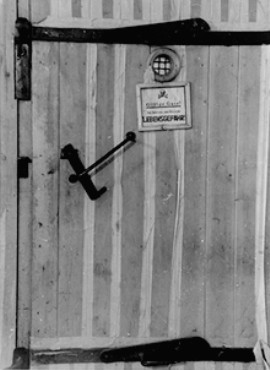
A door to a gas chamber in Auschwitz. The note reads: Harmful gas! Entering endangers your life. Image courtesy of USHMM Photo Archives via http://history1900s.about.com/library/holocaust

A door to a gas chamber in Auschwitz. The note reads: Harmful gas! Entering endangers your life. Image courtesy of USHMM Photo Archives via http://history1900s.about.com/library/holocaust

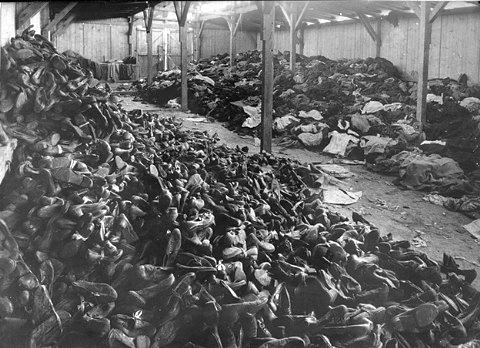
An Auschwitz  warehouse filled with shoes and clothing from those who were gassed upon arrival.  Image courtesy of USHMM Photo Archives via http://fcit.usf.edu/holocaust

An Auschwitz warehouse filled with shoes and clothing from those who were gassed upon arrival. Image courtesy of USHMM Photo Archives via http://fcit.usf.edu/holocaust

Omnipresent in Borowski’s stories is the theme of deception: deception by the Nazis, deception by both friend and foe and deception by strangers. That theme is magnified in the following: “It is the camp law: people going to their death must be deceived to the very end. This is the only permissible form of charity” (p. 37).


After being liberated in Dachau, Borowski lived in Bavaria, Paris and Berlin; finally returning to Warsaw in 1950. It was there, nearly 63 years ago, on July 1, 1951, that he gassed himself. He died two days later on July 3.  He was 28 years old.

Sadly, he was followed by others. Others who had peered into the soulless recesses of human eyes and lived to tell about it. Others like: Paul Celan in 1970, Piotr Rawicz in 1982, Primo Levi in 1987, and Jerzy Kosinsky in 1991. Surely there are others, many others. But these are those who survived to share their stories through a written medium. Those who left us with “Death Fugue”, Blood from the Sky, Survival in Auschwitz, and The Painted Bird. Those who live on in elegant typeface in books throughout the world. And through such, are immortalized.

After all these years, Borowski’s suicide still perplexes me. I wonder what went through his mind as he entered his kitchen, opened the gas valve and repeatedly inhaled. I wonder if he thought of his wife, who had bore him a daughter, Małgorzata, just three days before. Or of his friend’s arrest by Polish Security, the same friend at whose home Borowski himself was arrested 8 years prior. Or of the freight cars and the high, blue sky.

And I wonder what justice there was in such a death. And then realize it was not about justice but rather about hope:

Much of what I once said was naïve, immature. And it seems to me now that perhaps we are not really wasting time. Despite the madness of war, we lived for a world that would be different. For a better world to come when all this is over. And perhaps even our being here is a step towards that world. Do you really think that, without the hope that such a world is possible, that the rights of man will be restored again, we could stand the concentration camp even for one day? It is that very hope that makes people go without a murmur to the gas chambers, keeps them from risking a revolt, paralyzes them into numb inactivity. It is hope that breaks down family ties, makes mothers renounce their children, or wives sell their bodies for bread, or husbands kill. It is hope that compels man to hold on to one more day of life, because that day may be the day of liberation. Ah, and not even the hope for a different, better world, but simply for life, a life of peace and rest. Never before in the history of mankind has hope been stronger than man, but never also has it done so much harm as it has in this war, in this concentration camp. We were never taught how to give up hope, and this is why today we perish in gas chambers. (p. 121-122)

Tadeusz Borowski hoped for a better life. For peace and rest and flameless dreams. And perhaps, as much as he tried, it wasn’t possible. Perhaps Auschwitz and Dachau weren’t just horrendous experiences, set apart. Perhaps they became a part of him, like a song, and the only way to silence that song was by stepping on his own throat (20). Perhaps that was his peace.

Perhaps it was enough that he lived, survived and, above all else, loved.  He wrote: “I smile and think that one human being must always be discovering one another ̶ through love. And that this is the most important thing on earth, and the most lasting” (p. 110).

Perhaps there is hope in that.


WORKS CITED:

Borowski, T. (1976).  This Way for the Gas, Ladies and Gentlemen (B. Vedder, Trans.).  New York: Penguin.


A wife’s letter to her childless husband on Father’s Day


I lay in bed the other night, hands crossed over my heart and legs pin-straight, and thought of those words:

This is not about me at all, is it? This is all about you.

That’s what you said to me when I told you I wanted to have the procedure done. A procedure that would be risky, as any procedure is, but that might point us to what’s wrong. The answer to why our children are in the clouds and not here with us.

I was angry at you for saying such a cruel thing. So I went to bed in silence and didn’t tell you to sleep with God and dream with me like I always do. I didn’t kiss you or reach for your hand in reconciliation. I simply lay there, emotionally entombed, trying not to breathe too hard or feel too much as I waited for sleep to find you and take you deep into the hush of night.

But here’s what sleep whispered to me: you were right.

Much of the past six years has been about me. When I was pregnant it was all about keeping me healthy, happy and calm. And when I wasn’t, it was about the same. You took the brunt of my suffering and sadness. You held me when I cried and told me we’d be okay when I ran out of tears. You told me that I was more than enough, that the two of us were more than enough. And on Mother’s Day, when nearly everyone forgot to remember, you were there just as you always are.

Our first child would have turned five this year. My instincts told me she was a girl and this is how I’ve seen her in my dreams: a green-eyed chatterbox with my curly hair and your long lashes, running through a field of asters, buttercups and thimbleweeds. She’s always wearing a white eyelet dress with blue ribbon threading its hem. It’s soiled with what looks like chocolate ice cream and her knees are skinned. I hear her calling to you:

Daddy, Daddy, come find me.

Then she ducks behind a Black Maple, certain you can’t see her. You can, of course, and you find her, pick her up and swing her around as you tell her you love her. Then I wake up, still hearing your laughter, yours and our daughter’s.

I thought of this dream last Sunday as I watched you in the quiet moments before releasing your butterfly in the RTS (Renew Through Sharing) Garden.

Butterfly Release 2014_Ren_butterfly

And I wondered if you whispered I love you before you opened the purple envelope and let her fly away. A symbolic gesture of the sorrow we have felt and an acknowledgement of the tremendous weight of empty arms.

Butterfly Release 2014_butterflies

When I opened my own I sent some sadness with it: sadness for thinking my heartache went deeper because it could be seen and sadness for not honoring the differences in our grieving.  Because there are differences.

Perhaps you have always been strong because you felt you had to or because that’s just who you are. But I want you to know…

it’s okay to cry,

it’s okay to scream,

and it’s okay to shake your fist at the moon.

And it’s also okay to be silent. I know that now.

If we earned parenthood, if it was somehow based on merit, you would be a father because you deserve a child you can hold and touch and by whom you can be completely enamored. And you deserve to be called daddy in more than just my dreams. So, this Father’s Day, I hope you know how much you’re loved, both here on Earth and beyond where our angels reside.  And that it is about us.

Always us.

Always the five of us.

Butterflies_nook


First Love: What it Feels Like to Swallow the Sun

Image  courtesy of Izabela Zagaja-Florek via Flickr Creative Commons

Image courtesy of Izabela Zagaja-Florek via Flickr Creative Commons

Last Sunday I visited my old church meetinghouse. It’s the building I first walked into with my high school boyfriend. The building I was later baptized in. And the building where I still find much solace and peace.  After Sacrament Meeting came to a close, I stood, stretched and saw a familiar face a few pews ahead. It was somewhat different, of course. Tears of happiness and pain do that. Years do that too.

As I made my way forward, I wondered if I was so different than I was then. If he’d want to see me. Or if he’d rather leave the past there. In the past. But I wanted to see him. I had wanted to see him for some time.

When we were younger, my heart spoke loudly, but my mouth never echoed its song out loud. Hurt and pain stayed because I allowed them to. Deception stayed too. And despite forgiving him long ago, I had wanted to see him. To see if I had truly forgiven. To see if I had healed my wounds with the salve of my own heart. And my own truth.

After niceties were exchanged, we sat for a while. He told me about his families: the one he’d been born into and the one he’d created. And he asked about mine. We talked at length about high school. How he’d been lost, which I had known, and how he was sorry for the way he treated me, which I hadn’t. And I felt like I should say something then. Perhaps that I was sorry too. But he continued on. So I didn’t.

 
When he smiled, I couldn’t help but remember how I’d felt all those years ago. How first love strikes when you least expect. How it feels like netting stars and swallowing the sun. And how you are convinced. So convinced. It will never end.

But it nearly always does.

Image courtesy of quotes-lover.com

Image courtesy of quotes-lover.com

My first love ended. And when it did I was inconsolable. I didn’t understand how we shared so much and then shared nothing. How I was no longer the other half of the WE we had been. How it was just me. Alone.

Eventually, I understood the need to close that door. And the need to walk forward and open another. Then another. Eventually, I understood that odds are good we could have never made each other happy. And more importantly: that just because you share the past with someone, doesn’t mean you’ll share the future with them.

And that it’s okay not to.  It really is.

Image courtesy of quotes-lover.com

Image courtesy of quotes-lover.com

There’s a reason it’s called first love. Because there’s supposed to be a second and a third until you learn what love really is. And what it isn’t.

Love is giving your last cherry Jolly Rancher and taking the burnt piece of toast.
Love is putting the lid down.
Love is picking up dog poop. Even though you don’t own a dog, but do own a lawn.
Love is sharing the fluffy pillow.
Love is watching hockey instead of Criminal Minds. Only to realize hockey is better.
Love is reaching for your hand when drifting off to sleep.
Love is taking the trash out before dawn.
Love is making sure you put toothpaste on both brushes.  And always kissing goodnight.

Love is all the little things…
that make up a life.

So now, when I think about my first love, I’ll think about this one thing:

I’m happy he broke my heart.

Because it led me to The One who would rather break his own than break mine.

And that is what real love is all about.